A brand bible describes your brand identity in terms of vision, values, customer loyalty, message delivery, customer experience, and visual attributes. It is precisely one element that will ensure a strong and long-term bond between the brand and consumers for the purpose of loyalty.
This begs the question: what is the secret to creating an influential brand bible?
What Is A Brand And What Makes It Up?
1. Define your brand’s identity
Secondly, you need to pay attention to how your brand image is seen by others. Define your vision, mission, and code. Describe what makes your brand different from others and why you are here to help your customers achieve their dreams.
2. Research your target audience
You may be trying to build brand customer loyalty, but without insights into your target audience, you’ll hit a dead end. Collect demographic details, including preferences and pain points of your customers. Use this information to adjust how you write messages or talk about your products for them to resonate emotionally with buyers.
3. Design a brand history that will captivate your customers
Achieving brand loyalty requires creating emotional connections with customers. Create a unique storyline for your brand, which will explain why it exists, the reason behind its mission, and how the consumers can be transformed. It should make the audience feel and reflect the values of your target market’s audience.
4. Create a unique visual identity for your business
To develop a remarkable visual identity for your business, you should begin by producing a compelling logo, establishing a specific color palette, and selecting a font that best represents your company’s personality. Make sure these brand identity assets are connected to your brand story, values, and the needs of your potential audience.
Also, be creative and unique in the design, and try to create visually striking images that represent your brand and be memorable to your customers. A unique visual identity makes your business stand out and thus promotes brand memory and the significant presence of the brand.
5. Use consistent brand messaging
For success, your brand must always be in sync with your consumers. Hence, if you are curating your brand messaging guidelines, make sure you have a specific tone of voice, key messages, and language style. To have a coherent professional brand experience, ensure that all the touch points align with the brand’s visual identity, messaging, and values.
6. Seek customer feedback
What are people talking about you? Are you listening to what they have to say? And what proves it? Seeking and acting on consumer feedback helps show that you are loyal to them. Therefore, find out their opinions through questionnaires, social media platforms, or even panel discussions and tap into their insights.
7. Train and empower staff
The people you hire become the representatives of your brand and should understand your principles and values. Training them is the only way to ensure they consistently deliver brand experiences that foster consumer brand loyalty.
8. Communicate your commitment to quality
Reinforcing and communicating an unwavering dedication to the provision of top-notch as well as innovative services is a must. Through this, you not only solidify the trust of your customers but also set the benchmark for the quality of service expected in your brand. This commitment showcases a resolve to provide solutions or goods of exemplary standards that build customers’ trust.
Conclusion
To make a brand that can attract customers you need to write a Brand Bible that is distinct. Nonetheless, regular monitoring of the dynamic business environment and changing patterns of customer preferences is vital. Seek customer feedback from time to time and update with changes in accordance with their expectations.
In the tech ecosystem, generative AI (GenAI) has become a game changer in customer service and support. A Bloomberg Intelligence report estimates that the GenAI market will hit $1.3 trillion by 2032, up from $40 billion in 2022. However, while many companies remain bullish about deploying AI customer support, most still underestimate the requirements for deployment, according to an MIT Technology Review Insights global study.
How to Implement AI Without Destroying Customer Trust
Successfully deploying Gen-AI without disrupting customer trust and loyalty requires a systemic approach. This article will present a three-step roadmap for organizations while traversing this transformative journey.
Step 1. Build an AI-ready organization
The first step to successfully deploy AI customer support software into your CS is to adopt a data-centered mindset. By this, we mean combining data strategy, setting up the necessary data governance mechanisms and initial infrastructure, and implementing organization-wide data literacy programs.
An effective data strategy will spearhead all the decision-making regarding technology selection and assessment of use cases. Some of the questions leaders must ask include:
What functions could Gen-AI assist with?
How will AI improve our services or operations?
By answering these questions, leaders will be better placed to translate strategy into actionable roadmap.
Step 2. Out with the old in with the new
Once you’ve established a data strategy, the next step is to clean the knowledge base and customer data. Michael Boz, senior VP of innovation strategy at Salesforce, says that when businesses incorporate Gen-AI into poor customer self-service, they are only worsening the situation, albeit on a grander scale and with more severe repercussions than before.
Imagine an AI customer service software that always provides incorrect information due to a flawed underlying knowledge base. It will only become more proficient with Gen-AI. The only difference is that it will now be more confident disseminating false information, not because it is merely hallucinating.
Ed Thompson, senior VP of marketing at Salesforce, sees another route to implementing Gen-AI. According to Ed, old or unreliable knowledge base data is better off being scrapped altogether and the knowledge base filled with new content from scratch.
He further says that more than 40% of businesses begin from scratch knowledge acquisition from customer chats, emails, calls, etc. These businesses experience faster and more accurate creation of knowledge sources and a dramatically reduced risk of delusions.
Step 3. Getting it right for the customer
The secret to effectively adopting Gen-AI customer support bot lies in taking decisive action rather than getting paralyzed in a cycle of overanalyzing. You can start by identifying a specific use case and moving forward decisively.
Then, you can form cross-functional teams and employ a culture of experimentation and learning to reap the full benefits of GenAI. Leaders don’t lie around waiting for a solution – no! They identify a specific opportunity to benefit their customers and build around it.
Conclusion
Successfully deploying Gen-AI without disrupting customer trust requires strategic planning. It involves redefining your legacy systems and optimizing how you collect, analyze, and apply data to make faster, more informed decisions that add value to your customers. The key is to prepare your organization for the rollout, from forming teams to deploying the technology and customer engagement.
Jack Welch, the former CEO of General Electric, said, “Change before you are forced to.” As an entrepreneur, he understood that his competitors were constantly innovating. Failure to change always comes at our peril.
However, mastering change is so complex that Alan Deutschman, in his book Change or Die, says that in a life-and-death condition, only 10% of people will make the necessary adjustments to save their lives.
This shocking statistic, taken from a survey among critical heart patients in the US, also affects businesses, individuals, and organizations. The biggest obstacle to mastering change management is changing your perspective. Here are a few ways to help you make change happen.
Change Management Tips For Better Adaptability In Life And Business
1. Understand that event + response = outcome
This secret formula is available in many personal development and business self-help books. It implies that it’s not the event that matters but your response to it that determines its outcome.
You may be wondering how to use this formula to your advantage in the change management process. Well, one thing you can do, as exemplified by the formula, is to find various ways to disrupt that immediate instinctive heuristic response (R) to the event (E) and implement a new system that will potentially give you a better outcome (O).
For example, we had the Covid-19 pandemic, which is an event. The uncontrolled response was that lockdowns were enforced, and the outcome was that some businesses had to halt transacting while others folded up altogether.
But quite surprisingly, a few other companies thrived and blossomed during this period as they found a way to meet the changing needs of society then.
2. Be vulnerable and listen to your fears
As World War 2 reached its zenith, Allied commanders faced a significant crisis of low morale and desertions within their ranks.
Psychologists sent by the general command to investigate these phenomena were staggered at the findings. Soldiers most vulnerable to desertion were not those in dangerous close combat battles but those in their dugouts under instructions to hold the line.
The reason was quite evident. These troops lived in dread of attacks, but they couldn’t do anything to change the situation. They knew change would hit them, but their order was to hold on. Every day, they were plagued by fear and stagnation.
Just like those soldiers holding the line, when faced with change, our first impulse is to brace ourselves and confront the situation in a fight-or-flight mode. Consequently, we can become rigid and bent on holding the line in order not to become vulnerable.
However, vulnerability is actually a desired quality that comes from confidence and maturity and spearheads change management. Although it exposes our fears, we gain the courage to deal with challenges as they arise.
3. Say goodbye to the “Negative Nellies”
As you navigate through the rollercoaster of this life, you often look at images and create your story.
The narrative you buy from others or the one that you tell yourself usually becomes your reality. Jim Rohn once famously said, “You are the average of the five people you spend most time with.”
When handling change, nothing gives you more comfort than having people with whom you can share your doubts and fears—mentors and friends who will listen and cheer you on to be the best version of yourself.
Keep at bay dramatic people who seem always to attract chaos in your change management process. Worse still, they can’t elevate themselves and want to drag you down.
Conclusion
Heraclitus said that “change is the only life’s constant.” Mastering change isn’t just a one-time decision but a continuous dedication to growing and self-improving yourself. Regard change as your best friend and allow it to lead you to an extraordinary life ahead.
FinTech app development cost is critical for all financial companies planning to digitize their business processes. To estimate the detailed price, you should consider a wide variety of aspects, such as functionality, design complexity, platforms to cover, and architecture requirements. However, the most influenceable factors are development time and specialists’ hourly wages.
In this article, we provide a comprehensive coverage of calculating the approximate time and cost to create FinTech applications of diverse types, from banking to investment apps. This ensures that you, as financial professionals, are well-informed and catered to your specific needs.
Main Factors Influencing The Cost Of Creating FinTech Application
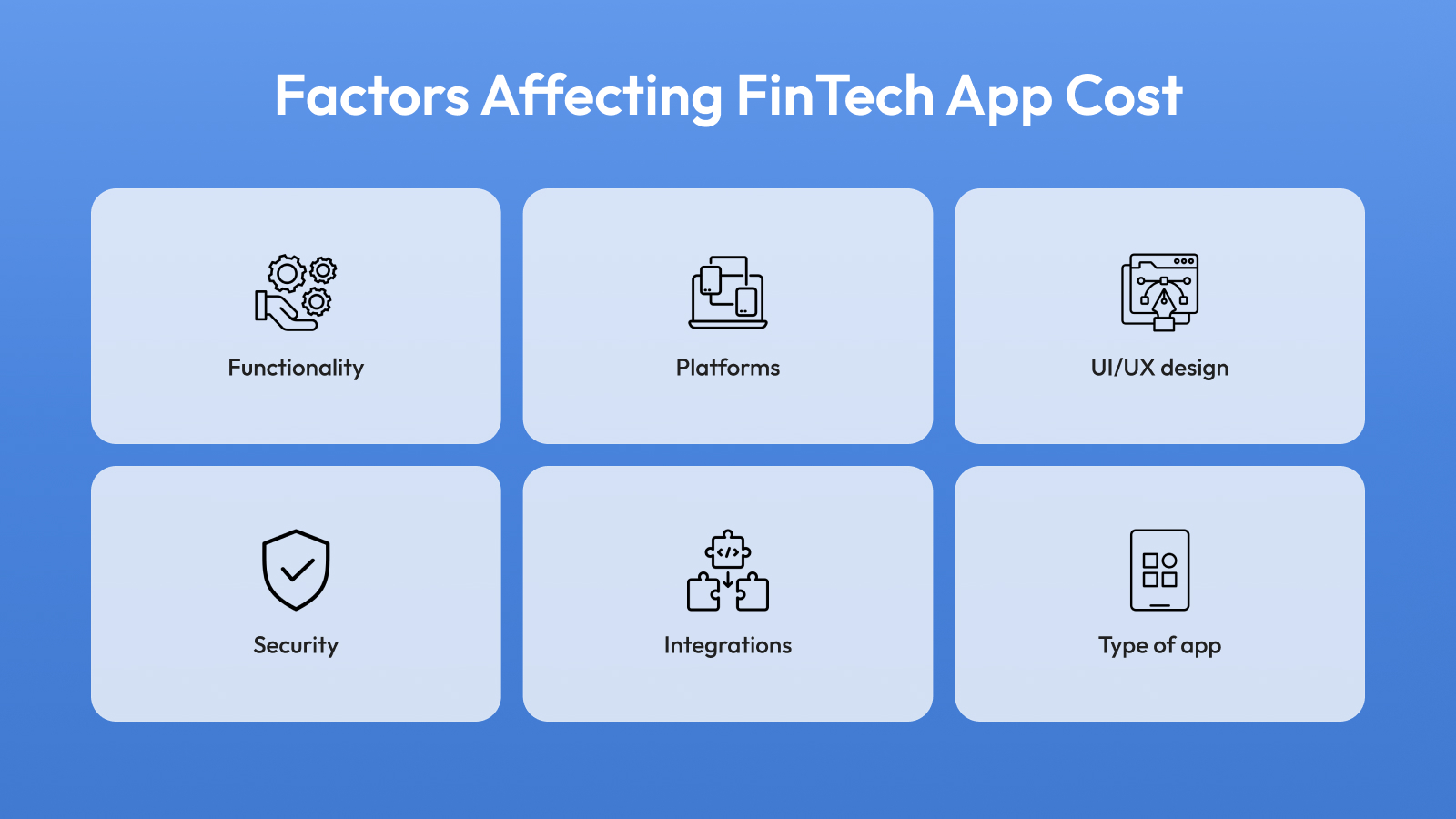
You might be wondering what aspects are the most critical to consider when estimating FinTech app cost. In this section, we will describe the main factors in detail:
Diversity and complexity of functionality
The functionality of your application significantly impacts the total price. More features require more time to develop, which increases the overall project duration. Moreover, you may need more complex technologies and deeper expertise to implement intricate functions.
Platforms to cover
Crafting an app for one platform (iOS or Android) requires less time, a smaller development team, and shorter resources than creating two separate native applications. However, if you aim to cover both platforms and want to reduce investments, here’s the deal: you can opt for cross-platform Flutter app development. Such a service allows the creation of two applications in a single code base, significantly reducing the cost of making a FinTech app. Flutter is a popular cross-platform framework that has been used to develop some of the best Flutter apps in recent years.
UI/UX design
Your app’s design is key to its success and appeal. You can use one of the popular templates to design your solution at a lower cost, but such a decision may reduce your competitiveness. If you want to engage more users, you should turn to a custom UI/UX design. But here’s the kicker: the cost of FinTech app design will also vary based on complexity: many pages with a variety of interactive elements increase the final price.
Security and compliance
Financial applications require a special approach to data protection since they operate sensitive user data. Moreover, FinTech solutions adhere to strict industry regulations that demand implementing particular functionality to ensure compliance. You can integrate only basic security measures that enable you to comply with regulations to lower initial investments. However, we highly recommend improving your app’s protection with robust tools such as biometric authentication, industry-specific data encryption, etc.
Integrations
Suppose you want to build a FinTech app integrated with other software solutions in your business ecosystem. In that case, you should be ready to spend initial costs to provide seamless interaction. Moreover, expanding your platform’s capabilities with third-party service integrations can also increase the overall project price. This is wild, but these expenses are only for the best: your FinTech app will be able to provide a seamless user experience and attract more clients.
Type of FinTech app
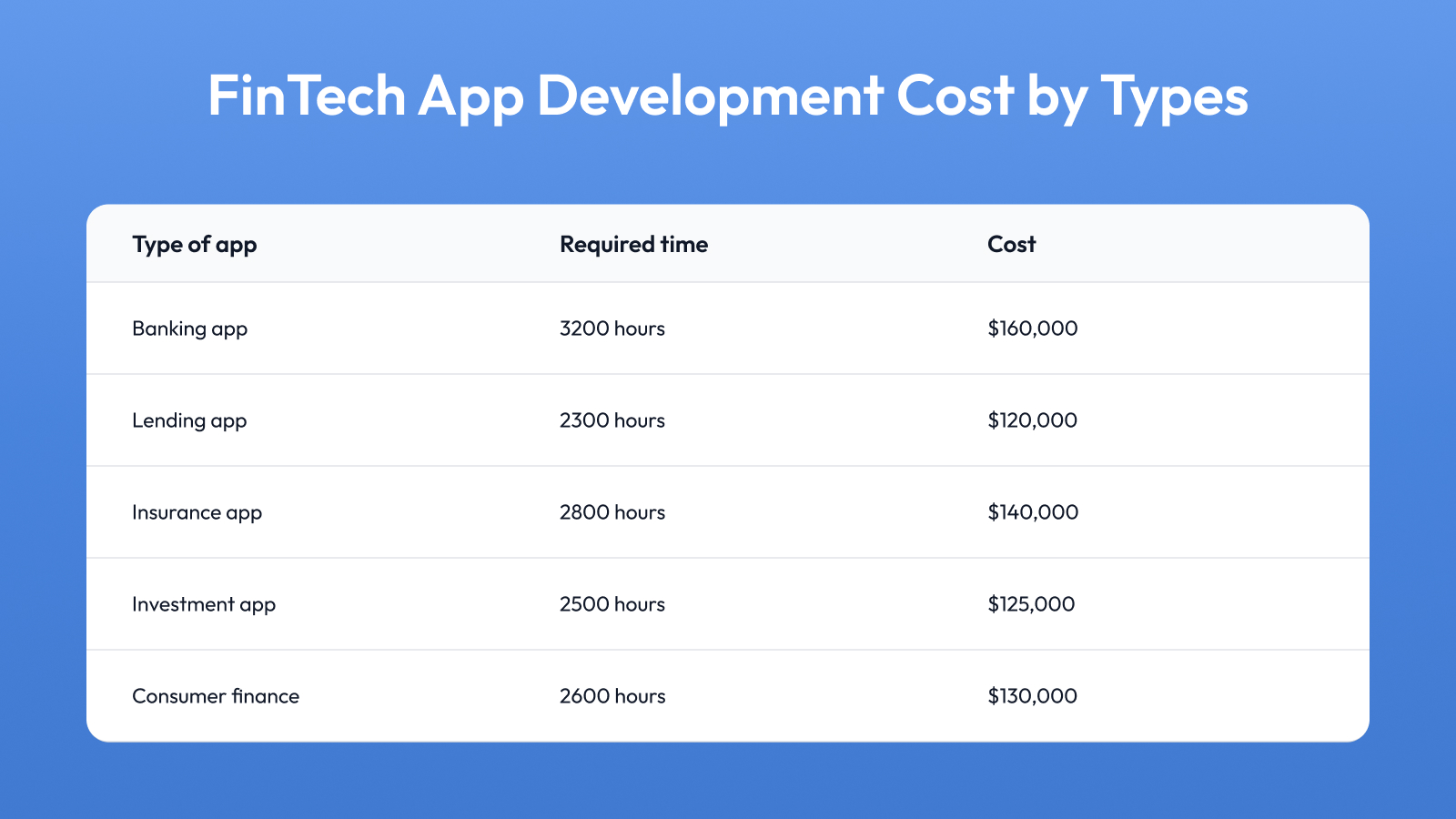
There are various types of financial applications, each of which requires the implementation of unique features and sometimes adheres to distinct regulations and laws. Accordingly, the cost of a FinTech app can change from type to type. For example, banking solutions require more development time than landing or investment apps.
FinTech Applications Cost By Type
As we already mentioned, each type of financial application has its own features, so its price is different. Now, we will briefly overview the main FinTech app types and their costs.
Banking app
Banking applications are digital solutions aimed at expanding traditional banking institutions’ capabilities or even replacing them. Such solutions allow clients to perform various operations with their accounts via mobile devices. Banking apps usually enable you to check your balance, make P2P transactions, schedule payments, find ATMs near you, etc.
Lending app
Lending apps are created to connect people who are ready to lend money with people who need to borrow it. These platforms streamline the lending process by offering a convenient digital interface where lenders and borrowers can easily find and interact with each other. By using lending apps, borrowers can access funds quickly and often at more competitive rates than traditional financial institutions, while lenders can earn interest on their money with minimal hassle.
Insurance app
Insurance applications streamline and automate classical services. There are several types of such solutions depending on their purpose:
Claim settlement
Travel insurance
Sales management
Car insurance
Broker app
Investment app
Investment platforms are handy tools that allow beginners and experienced investors to manage their funding conveniently and “on the go.” So how to build an investment platform? Remember that it should provide rich functionality that includes not only basic features like buying and selling assets but also comprehensive analytics and reports to help users make informed and effective decisions.
Consumer finance app
This FinTech app type is aimed at effective finance management. It provides wide functionality, allowing users to control their spending by categories, set goals, and control their performance.
What’s the bottom line? The time and costs required to develop these solutions vary. Here are the approximate calculations based on the hourly rate of $50 per hour, which is typical for the Central and Eastern Europe (CEE) region.
How The Choice Of IT Partner Impacts FinTech App Development Costs
So, we’ve already explored some of the critical FinTech app’s cost-driving factors. Now, we should discuss how your software development team’s selection may affect the price:
Cooperation model
There are three possible hiring options for FinTech app development:
In-house team. You can hire a whole development team to work in your company. This option provides you with the highest control level but implies additional expenses for office rent, hardware, wages, insurance, etc.
Staff augmentation. You can hire all essential specialists from an outsourcing software vendor but still maintain complete control over your project. This option allows you to save time on hiring and cut expenses.
Dedicated development team. This cooperation model implies hiring a whole team for FinTech app creation from an outsourcing provider. You completely outsource your project to an external vendor, freeing up your time for other business tasks.
Region and hourly rate
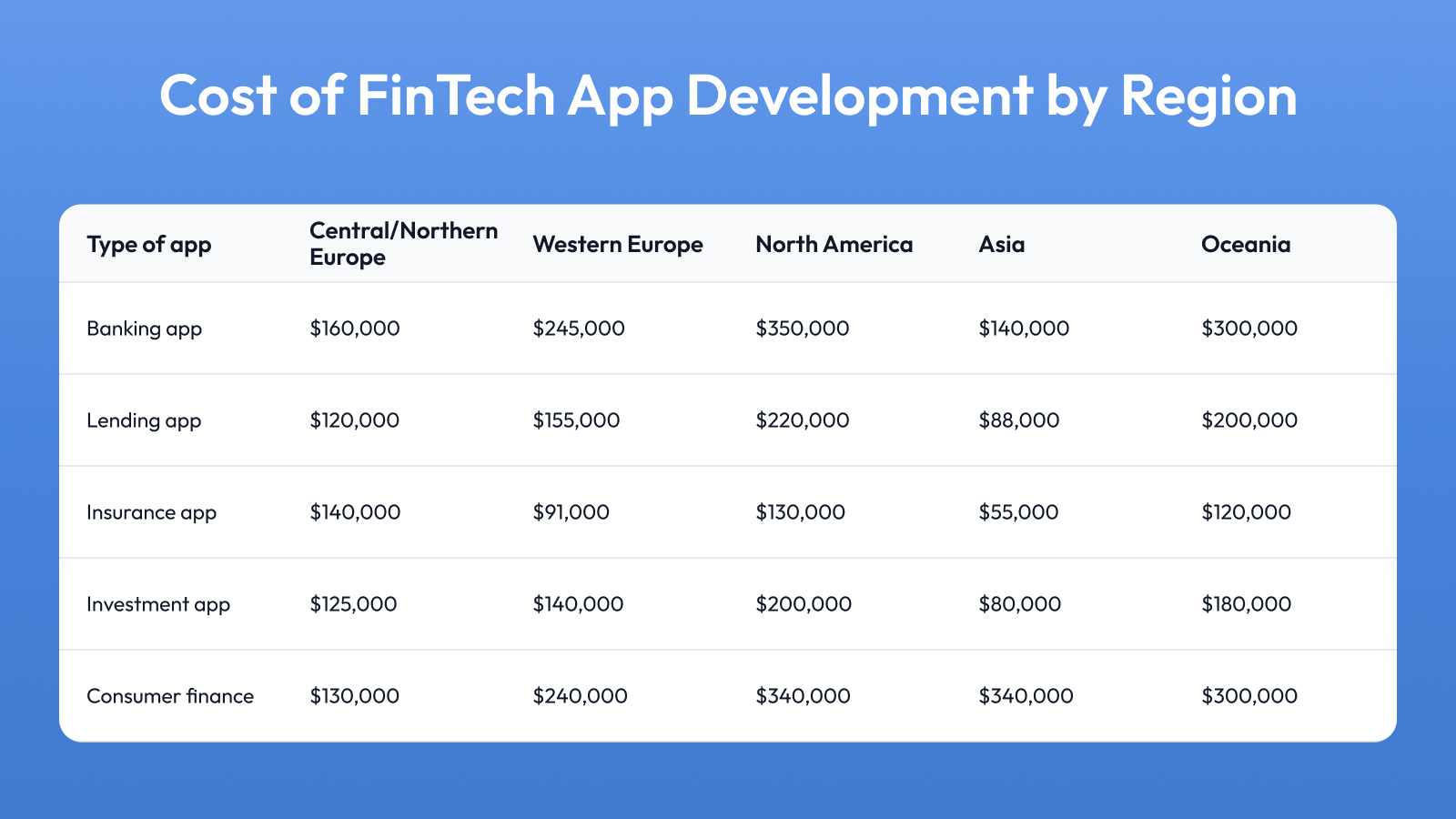
Another factor that has a tremendous influence on the FinTech app cost is your software development team’s hourly rates. This variable depends on geographical location. The cheapest regions are Asia, India, and Latin America: they offer software development services at $40-$60 per hour. Canada, the USA, and Western Europe are the most expensive ones – IT specialists here charge $100-$200 hourly. The most popular outsourcing regions today are Central and Eastern Europe. It is famous for a huge number of software providers who provide high-quality services at a reasonable price – $50-$80 per hour.
You can see how your software provider’s location can impact the cost of building a FinTech app below:
Conclusion
To summarize, the cost of FinTech application development can vary from $50,000 to $350,000+. The exact numbers depend on a vast array of factors we’ve explored in this article. If you want to get a detailed estimate, you should turn to a reliable software provider with deep expertise in the FinTech domain and share the idea of your future project. Thus, you’ll receive not only price calculations but also comprehensive consulting and development services.
Author bio
Yuliya Melnik is a technical writer at Cleveroad, a software development company in Ukraine. She is passionate about innovative technologies that make the world a better place and loves creating content that evokes vivid emotions.
SMEs are the lifeblood of our economy, creating jobs and driving innovation in communities across the US. However the Bureau of Labor Statistics, 18% of SMESs fail to take off in their first year of operation, 50% after five years, and 65% collapse before they reach ten years. One of the most common reasons for this high failure rate is underfunding.
This article will show different ways of securing funding for small businesses.
4 Proven Tips To Secure Small Business Funding
1. Weigh your funding options
Before you begin your journey of securing funds, you need to understand your business’s specific funding needs. Different funding sources are also available, so it’s entirely up to you to determine which ones best match your business needs.
Venture capital and angel investors finance high-potential startups in exchange for a slice of the business’s equity. Crowdfunding platforms, on the other hand, are ideal for obtaining funding from a large pool of people who believe in your business idea. Government grants and programs support businesses in specialized sectors or industries at the local, state, and national levels.
2. Strong business plan
A Harvard Business Review study revealed that having a stunning business plan before pitching increases viability before investors by 16%. Another DocSend’s Startup Index showed that venture capitalists now take only 3 minutes to consider your deck. And that’s assuming you succeed.
Your plan should be simple, data-driven, and drilled down on your business numbers, USP, and market opportunity.
3. Nurture relationships with investors
Building ties with various investors not only paves the way to winning investor funds round after round but also makes operating everyday business easier, especially if you’re working with your board of directors.
The best way to get funded on the best terms is to build rapport before you need their capital. At the very least, strategic relationships are built a year in advance. This period is when you’ll start prioritizing meetings and facilitating connections with founders of startup accelerators and angel investors.
4. Follow up and be persistent
Once you complete the long and arduous application process and submit it, you might be tempted to sit back and wait for their response. But following up with the funding organization is important as it gives them the impression that you are committed to your business’ prospects and increase your chances of receiving the funding. Here are some tips for effective follow-ups:
Send a thank you note to the funding committee, appreciating them for their time and consideration
Check-in periodically with your potential funders to see if they require any additional information from you, but don’t inundate them with too many calls. One or two calls should be enough.
Ask about future funding cycles even if they don’t award you the funds.
Conclusion
Whether scaling operations, investing in novel technology, or ramping up marketing campaigns, investor funding offers a much-needed financial stimulus. Fortunately, there are different ways of securing funding for small businesses. Of course, the application process may be competitive and rigorous, but the payoff far outweighs the risk of not trying at all.
In AI computing, two AI development platforms, Microsoft Azure and Amazon’s AWS, stand out for their performance and market dominance. But, another relatively new kid on the block, Google Cloud Platform (8.9 % market share), doesn’t usually get as much press as Azure and AWS, especially in everyday corporate IT.
However, if you switch from office-bound networking to cloud solutions optimized for remote employees, Google Cloud is as capable as any of its rivals. This GCP review will break down its features, performance, and other parameters to see whether GCP lives up to its hype.
What Is Google Cloud AI Platform?
GCP is a managed service offering customers access to AI computing resources stored in Google data centers worldwide for free or on a pay-as-you-go basis.
GCP is ranked 6th among the top AI development platforms. Most users give it a rating of 7.7 out of 10, and it’s most popular among the large enterprise segment.
The users prefer Google Cloud AI due to the following benefits:
Easy setup
Once upon a time, you needed to be a computer whiz kid to use Google Cloud, but nowadays, the setup has shifted from the complicated command line to a new graphical user interface (GUI). Thanks to this GUI, you can use a browser to access screens and menus, and once you complete the server configuration, you can also use its GUI.
The cherry on the cake is that if you are a first-time GCP user, you are automatically credited with $300 worth of trial credits to test the platform and see if the platform and features work for you.
High performance
GCP AI has scaled up its footprint globally, now covering 35 regions, 105 zones, and 174 network edges, serving customers in over 200 countries. With Google announcing even more cloud regions at its Next ‘23 conference, it’s safe to say that there is a data center wherever you are.
In a previous statement, Google said that each data center is continuously being upgraded and retrofitted with the latest Google Axion Processors. GCP’s internal network now achieves speeds of 16 Gbps, providing a secure connection between regions and offering capabilities that are developed enough to compete with IBM Cloud, Azure, and AWS.
Pricing
Pricing is best assessed on a case-by-case basis, and Google provides a straightforward approach to this with a pricing calculator and accessible price sheets. Just like Azure and AWS, all prices are in U.S. dollars – which makes comparisons easy. However, it exposes non-US users to fluctuations in exchange rates.
As for contracts, Google’s Compute Engine’s SLA guarantees a minimum uptime of 99.99%. If you experience a monthly uptime percentage ranging from 99.95 to 99.99, you get a 10 % credit refund; 95 to 99% attracts 25%, and below 95% gets a 50% refund.
Pros
GCP AI is a powerful AI computing platform that features excellent support for Linux and Windows
Its broad reach of global private networks offers unparalleled speed and seamless connectivity
Features a suite of data analysis and AI apps
Cons
It is significantly more expensive than AWS
You might experience difficulty integrating it into non-Google products
Conclusion
Although Google is still struggling with the bad reputation of killing off services, GCP Cloud AI remains a secure and reliable foundation for the company’s infrastructure, so it’s less likely to be placed on the chopping block any time soon. But if your company’s network and server infrastructure revolve around Microsoft products, go for Azure.
Editing software like Grammarly and Hemingway can augment your word processing software’s basic spell check and built-in dictionary features.
These powerful editing solutions have unique features to handle your specific writing requirements, whether validating for clarity, plagiarism, or grammar.
In this Grammarly vs. Hemingway review, we’ll analyze each tool in depth to help you decide which service to use for your writing and editing needs.
Who Should Use Grammarly?
Grammarly is the best choice if you need help defining your writing tone, clarity, and grammar mistakes.
This editing and proofreading tool is beneficial for a non-native English speaker who wants to come across as fluent in the English language.
Grammarly combines proofreading and plagiarism-checking functionalities in one – making it a huge cost saver for students and content marketers.
Who Should Use Hemingway?
If you write long, technical prose, Hemingway is your best pick. It’ll help you focus on clarifying and simplifying your writing.
Professional bloggers will also appreciate the convenience of the HTML and WordPress functionality in the paid version.
Hemingway allows users to shorten sentences and use simpler words to achieve an easily digestible level of writing that engages readers.
Grammarly vs Hemingway Features
Editing
There are several differences between Grammarly and Hemingway tools regarding where and how you edit. Hemingway’s editor has an intuitive design that allows even a newbie writer to head to their page and begin writing immediately. Its clear visual guide will enable writers to identify errors, while the writing mode provides a distraction-free environment.
Grammarly works everywhere and on all devices. The free and paid versions can be used as a desktop app, mobile app, browser extension, Google Docs, or on the web. It provides suggestions including alternative words and phrases to use and the right punctuation to improve the grammar and flow of your writing.
Reports
Grammarly’s primary role is to check for grammar errors. Grammarly will pinpoint confusing or wordy sentences, provide rephrasing hints, and other sentence structure issues.
Hemmingway app focuses on improving readability and style. It will give you a readability score based on the Flesch-Kincaid metric and provide goals for each report based on your total word count.
Pricing
Grammarly’s free version has basic features but lacks necessary tools, such as the plagiarism checker. On the free version, you won’t be able to correct punctuation, tone, run-on sentences, style, and word choice. Grammarly’s single-user monthly plan is roughly $15, while the three-person access business plan is about $12 per person.
Hemmingway is also free to use for the most part, but its premium features require a subscription. Hemingway’s paid tier costs $19.99, after which you’ll access all the best features, such as offline use, WordPress, and importing and exporting files.
Benefits of Hemingway Vs. Grammarly
Hemingway is cheaper than Grammarly; once you subscribe to its one-time paid version, you get life-long access to all its features
It has more accurate grammar suggestions
To use this app, you don’t need to download anything or open an account
Limitations of Hemingway Vs. Grammarly
You can’t always accept whatever the tool suggests because you’ll lose your tone and style of writing
Since Hemmingway doesn’t save your work, you’ll lose whatever you were working on if you close the page
Benefits of Grammarly Vs. Hemingway
While Grammarly is available on Android and iOS, Hemingway isn’t
You can integrate Grammarly with browsers like Google Chrome or processors like MS Word
Grammarly is also ideal for writing directly into your word processor due to its free plug-in
Limitations of Grammarly Vs. Hemingway
Grammarly’s free version has many restricted features, while the paid tier is too costly compared to Hemingway
Grammarly won’t give you input on your write-up readability
The free version has a word limit of 1000 words, making it difficult to edit documents over five pages at a time.
Conclusion
If you are still confused about choosing between Hemingway and Grammarly, remember that Grammarly is the best solution for improving grammar, sentence structure, or spelling. Hemingway’s paid version is ideal for enhancing writing tone and style. A combined use of these solutions gives you the best of both worlds.
The picture of leadership has changed dramatically over the last ten years, giving rise to a scenario where a leader’s performance depends a lot on their network. When you think about it, you will notice that old-fashioned networking patterns no longer apply in an environment where technology develops at incredible rates.
This blog acts as a guide for leaders who seek success in this age and provides them with progressive-minded networking tactics.
4 Ways To Optimize Your Networking
1. Adopt a diversity mindset
Research shows that the composition of your network is more important than its size. Another London Business School study emphasizes the importance of understanding and strategically classifying your network into personal, operational, and strategic groups.
Operational networks comprise colleagues and other internal contacts who help you accomplish routine tasks and maintain operational workflows.
Personal networks include industry peers or mentors with similar career paths or interests to yours. These people allow you to grow your professional journey outside your company.
Strategic networks transcend your immediate operational area and impact your organization or career success. This group can be influencers within your industry, high-level professionals, or senior leaders who can open new doors.
2. Start mentoring
Mentorship programs benefit any individual or organization, and data backs up this fact. 75% of business leaders said that mentorship played a big part in their success. Another study revealed that 96% of mentees found mentoring helpful in learning from their mentors’ successes, mistakes, and overall experiences.
However, mentors can also benefit from their mentees. A study showed that 75% of mentors said participation helped them develop their leadership skills. For success, mentorship requires the mentor to reflect on their career to support the mentee’s growth – which can be a valuable learning exercise.
The mentor can train many mentees who will eventually move to work for various positions in other organizations. These mentees will form the backbone of a strong network of people representing the mentor’s name for years or decades.
3. Attend virtual mentorship programs
Participating in virtual events will expose you to skills and essential resources from your peers and industry experts. You will build genuine connections that can last for a long time. Plus, attending these events can give you the rare opportunity to share your experiences and knowledge, allowing you to position yourself as a reference in your industry.
Girls in Tech is an example of an event where attendees network virtually with others across the tech world. The one-day extravaganza held on September 9 includes a virtual career fair, online courses, and ad-hoc chat sessions where people can develop their networking skills.
4. Become a connector
Actively participate as a connector in driving collaboration amongst members within your network or contacts. Identify what individuals are good at and bridge the gaps by fostering synergy among complementary people and interests. Do not just network out there for personal gains but also as a way of helping others in strengthening your relationships. By doing so, you help build an environment where meaningful networks will flourish, raising everyone’s bar.
Conclusion
An effective leader understands that a better future requires using the right strategies to conscientiously and purposefully enhance their networks. However, our networks don’t have to remain static; we must align our networking style with our changing needs and professional phases.
Quintessential, high-quality customer service has become indispensable in today’s burgeoning luxury hospitality industry. A PwC report shows that affluent customers are willing to break the bank by paying as much as 16% for exemplary customer experience.
It’s no wonder general managers of leading hotel brands are rushing to hone techniques that drive customer success.
4 Strategies For Memorable Customer Experiences In The Hospitality Sector
1. Bespoke activities
Now that wellness centers and infinity pools installation have become too common in resorts, many hotels are trying to stand out by offering exquisite activities that are increasingly bespoke and Instagrammable.
“We are leaving no stone unturned in finding innovative things for our visitors to do,” says Olivier Lordonnois, M.D. of Aman Luxury Resorts in New York. “This can mean delivering exclusive behind-the-scenes tours of artists’ studios ($7,500), implementing immersive workshops on handcrafted sushi, or exclusive fish prep classes ($750).”
The Clayoquot Wilderness Lodge, nestled in the rainforests of Vancouver Island, offers helicopter rides for mountaintop adventures ( $475), salmon fishing, canyoning, and more.
Corey Lens, assistant G.M. of Hidden Pond in Kennebunkport, ME, says, “We go to great lengths to provide a wide variety of activities for our guests, including those that are part of the room rates such as watercolor lessons, forest-bathing sessions, and visits with orphaned turtles.”
2. Localized stays
Unique local touches equal unforgettable stays. The most successful luxury hotels go the extra mile to offer guests local experiences. Whether it’s local tradition, décor, regional delicacies, or traditional music, these unique touches provide guests with an experience not found elsewhere, not even by generic chains.
Hyatt Hotels & Resorts focuses on offering personalized customer experiences, including local cuisines in its global locations. When you visit the Grand Hyatt in San Francisco, you’ll witness a dazzling art display from local artists displaying the city’s indomitable vibe.
That’s not all. Hyatt’s Andaz deluxe Tokyo hotel has Japanese “Matsuri” culture elements interspersed throughout the customer journey to make guests feel part and parcel of Tokyo’s heart and soul.
3. Exclusive kitchen access
Annabel Rayer, global communications head for IHG-affiliated brands like InterContinental, Regent, and Senses, among others, says offering customized experiences in luxury hotels is non-negotiable. “Merely offering a three-Michelin Star meal just doesn’t cut it anymore,” she says. “Guests want to meet the chef and understand everything behind the scenes.”
For example, at the InterContinental London Park Lane, guests can take a kitchen master class led by Michelin-starred chef Theo Randall before tucking into a carte du jour.
4. Data-driven hospitality teams
Customers feel special when staff meet their needs before even expressing those needs. Such anticipation only occurs when staff have actionable data about their customers. That’s why outstanding hotel brands invest heavily in upskilling their employees to serve customers banking on important data.
CRM implementation, for instance, can track repeat client preferences and relay this information to employees efficiently and timely. The result is a super-customized service where the customer speaks less because everything is as they wish. “Welcome back, Mrs. Smith. We have prepared your usual table.”
Marriot has a training program for all its employees because the luxury hotel wants genuine and positive interactions between guests and staff. To this end, the hotel regularly adjusts to keep employee satisfaction scores high. This move aligns with Mariott’s founder, J. Willard Marriott, who said, “Happy employees make the customers happy.”
Conclusion
Hotel experts predict that the arms race for more creative and bolder experiences is only heating up. “Guests yearn for new experiences as they seek a break from algorithm-based services,” says Gills, who oversees guest relations at the Langham, Chicago.
Luxury hotels that want to remain competitive constantly push the boundaries of guest experience to give their guests genuinely memorable stays.
In an era marked by rapid technological advancement, the realm of education has undergone a profound revolution, thanks to the rise of mobile learning. With the global pandemic acting as a catalyst for change, the adoption of mobile learning has become more than just a trend—it has become a necessity. This blog will explore the journey of mobile learning, its integration with custom app development, and the potential it holds for the future of education.
What is Mobile Learning?
Mobile learning, often referred to as m-learning, is an innovative approach to education that leverages mobile devices such as smartphones and tablets to deliver learning content. It offers the flexibility to access educational materials and resources anytime, anywhere, breaking down the barriers of traditional classroom learning. This dynamic method fosters engagement, interactivity, and individualized learning experiences, catering to a diverse range of learners.
The Rise of Mobile Learning
The ascent of mobile learning can be attributed to the increasing ubiquity of smartphones and the transformative power they wield. According to Statista, the global number of smartphone users reached a staggering 4.5 billion in 2020 and is projected to rise further. This surge in smartphone usage has paved the way for mobile learning to transcend the boundaries of conventional education, making knowledge dissemination more accessible and convenient.
Pandemic-Driven Transformation: A Compelling Shift
The outbreak of the COVID-19 pandemic marked a turning point in the history of education. The closure of physical schools and institutions compelled educators and learners to pivot towards online and mobile learning. Educational institutions worldwide had to swiftly adapt to digital platforms to ensure continuous learning. As a result, the pandemic acted as a catalyst, propelling mobile learning to the forefront of education. According to UNESCO, the pandemic led to the closure of schools for over 1.6 billion students worldwide, highlighting the urgent need for innovative learning solutions.
Empowering Learning through Custom App Development
The synergy between mobile learning and custom app development has been instrumental in shaping modern education. Custom app development empowers educational institutions and developers to create tailored learning experiences that cater to the unique needs of learners. In the case of the PTE exam preparation app, it offers a personalized and interactive platform for students to prepare effectively for the PTE exam. Let’s delve into some of the key features that custom app development brings to the realm of mobile learning:
Adaptive Learning Algorithms: Custom-built apps integrate adaptive algorithms that analyze learner progress and behavior. These algorithms dynamically adjust the learning journey, offering personalized content and assessments. Duolingo, a language learning app, exemplifies this by identifying and addressing areas of difficulty to enhance the learning experience.
Enhanced Engagement: Gamification elements, interactive quizzes, and multimedia-rich lessons foster heightened engagement and motivation. A study by eLearning Industry reveals that gamified learning apps can lead to a remarkable 14% higher skill-based knowledge retention rate, compared to traditional methods.
Seamless Accessibility: Mobile apps erase geographical boundaries, ensuring education is accessible to all. Learners, irrespective of their location, can access a wealth of resources and lessons at their fingertips, democratizing education like never before.
The Future of Mobile Learning
The future of education lies intertwined with the potential of mobile learning. As technology continues to advance, the possibilities for education are boundless. Custom app development is set to further enhance learning experiences through innovative features such as augmented reality (AR) and virtual reality (VR), offering immersive and interactive lessons. Additionally, the integration of artificial intelligence (AI) will facilitate more sophisticated adaptive learning, providing students with even more personalized and efficient learning paths.
Furthermore, the future holds promise for collaborative learning through mobile apps, allowing students to engage in group projects, discussions, and knowledge-sharing regardless of their physical locations. As 5G technology becomes more prevalent, the speed and reliability of mobile networks will further enrich the mobile learning experience, enabling seamless streaming of high-quality educational content.
Conclusion
Mobile learning, fueled by custom app development, is ushering in a new era of education characterized by accessibility, engagement, and personalization. From its humble beginnings to its pivotal role during the pandemic, mobile learning has proven its significance in transforming traditional educational paradigms. As we look ahead, the fusion of technology and education will continue to shape the landscape of learning, empowering individuals worldwide with the tools they need to thrive in a rapidly evolving world. The journey is far from over, and the future of mobile learning is undoubtedly bright.
Author Bio
Keval Padia has put his 14 years of IT experience into Nimblechapps and has kept it up and running at an exponential pace. Keval is a bookworm and likes to read auto-biographies and biographies of anyone who has achieved great heights in their respective fields. It is his passion that has enabled him to manage people, clients, time, and everything into one thread. He is a hot-headed CEO in good terms who keeps the fire ignited in the company.