While the tech industry has made noteworthy strides over the last few years, gender disparity is still prevalent. Data by the U.S. Bureau of Labor Statistics shows that women constitute only 28% of IT roles despite making up 47% of the workforce.
Additionally, according to McKinsey, the gender disparity in tech leadership roles remains vast, with women facing an 18% less likelihood of being promoted compared to men.
Despite these statistics, there is a growing recognition of the need to empower women in technology. Here are seven strategies for companies to support the tech for women agenda.
7 Actionable Ways To Nurture And Cultivate Female Tech Talent
1. Eliminate gender-biased recruitment processes
Companies must proactively address biases during the recruitment and promotion of tech talent. A 2022 McKinsey report established that only 52 women out of 100 men are promoted to manager.
These numbers are even lower in the tech roles, with women holding only 30% of software and 17% of hardware roles at the SVP level.
Company execs must develop guidelines for interviewers to reduce gender biases during recruitment. These steps can include anonymous resume reviews, structured interview formats, and diversity training for vetting teams.
2. Promote gender diversity at the leadership level
Another critical step a company can take inempowering women in technology is to give women equal opportunities to attain leadership roles.
When women occupy influential roles in organizations, they show young women contemplating careers in tech that the industry is open to everyone, irrespective of their gender.
3. Implement women-centric mentoring and training programs
According to a Pew Research Center report, male-dominated workplaces cause 79% of women to feel the urge to prove themselves. But, by implementing mentorship and training programs, women in the workplace will receive practical support and credit for their efforts.
However, tech for women mentorship programs shouldn’t just provide skill development. They should also address women’s challenges and obstacles in the tech industry.
4. Improve work-life balance
Striking a balance between work and personal life is vital for the well-being of all tech industry employees, including women. Leaders shouldn’t only offer lip service to it but proactively implement guidelines to support it.
Women in tech find it more complicated than men to establish a healthy work-life balance because they have to juggle more responsibilities outside work.
A study by Deloitte established that women are more likely to leave their jobs if their hours are inflexible. 14% cited a lack of flexibility, while 12% mentioned an unfavorable work-life as the main cause of why they quit.
5. Offer comprehensive benefits
HR decision-makers should think about providing benefits that are customized for women in tech.
These benefits could include equal pay with men in the same roles, comprehensive maternity leave policies, and lifestyle spending allowances.
These efforts can showcase your company’s dedication to fairness, support of women’s mental health and well-being, and the empowerment of women to balance family and career obligations.
Women need encouragement to participate in community and networking events. This can be accomplished by exposing them to fellow women in tech-related organizations and societies.
Companies can allocate specific budgets and hours for these activities. By participating in relevant networking groups, women in IT can share experiences, expand their networks, and access valuable mentorship.
7. Introduce inclusive team-building and social events
Social events can inadvertently exclude women if not planned carefully. Tech managers should offer a variety of team-building activities that appeal to diverse interests and backgrounds. Doing so will promote a culture of inclusivity.
Conclusion
Company leaders have an essential role to play in empowering women in technology. These efforts don’t just bridge the gender gap but also create a future where everyone can thrive and realize their potential.
With proper decision-making, crises can be the stepping stone to success. However, if met with indecision and ill-advised choices, things can go downhill rather quickly.
We spoke to a few business leaders and experts and found out these brain-busting choices they had to make in 2023.
4 Most Challenging Decisions Of Business Leaders In 2023
1. Fire or retain talent
Rising global inflation has put a huge strain on company finances, reducing access to essential capital. Morgan Stanley, Twitter, Facebook, and many other major companies have laid off thousands of workers. Just yesterday, Pfizer announced plans to cut 781 jobs in its New Jersey plants.
However, many leaders have learned the hard way that mass layoffs don’t always help company finances. Layoffs can be costly. You’ll have to provide severance packages and unemployment insurance while dealing with reduced productivity and low morale among the remaining teams.
2. AI automation vs human expertise
While failure to implement AI means getting left behind, a careless implementation of AI is even worse. In August, newspaper company Gannett faced a cringeworthy public embarrassment when several of its articles, written with an AI tool, went viral for grammar mistakes, repetitive content, and fluff. A CNN report highlighted misplaced facts, names, places, and people in Gannet’s papers, including the AZ Central, Florida Today, and the Louisville Courier-Journal.
“The hardest business decision I had to make this year is outsourcing our marketing and social media engagement to a professional digital marketer,” says Mafe Aclado, GM of Coupon Snake. “I learned that employing a skilled professional is worth every penny. The reward of success that comes from spending on those factors that help promote the image of our brand, as well as help better maximize efficiency, makes the spend profitable and totally worth it.”
3. Climate change
Occasionally, business leaders have been led to believe that climate change is a “third-world” problem. They have been told that countries north of the globe are safe or could even benefit from a warmer planet with positive effects on agriculture and weather.
However, based on 2023 reports, company assets in the US are severely becoming susceptible to climate change risks. One key finding shows that between now and 2050, businesses could lose $0.45 per dollar of their operating capital due to climate change.
Earlier in the year, shareholders filed close to 540 proposals asking companies to address climate, social, and corporate governance issues. Climate-change-focused resolutions accounted for more than 25% of these shareholder petitions.
4. Return to office
It’s becoming increasingly difficult to get employees back to the office. Trending internet videos highlight how Gen Z workers want to change: freedom, flexibility, and work-life balance. A great number of them have quit their 9-5 jobs to pursue their hobbies and passions.
“One of my challenging business decisions was asking my teams to return to work after trying a hybrid model,” says Mladen Maksic, CEO of Play Media digital agency.
“The decision was tough since employees could decide which option they preferred more. Because it was their decision and the possibility to exercise their right, I had to think about my decision thoroughly and how to execute it to avoid potential drawbacks.”
“I noticed that my team became more distant and much more task-oriented. Everything seems like a job and not like we’re building something together. I didn’t want to rush them to come to the office, but I tried to encourage them daily to work more on their ideas and projects.”
Conclusion
2023 might have been the toughest year for business leaders. Following the pandemic and face-to-face with inflation, AI, and other disruptions, business leaders had to make tough decisions. But by studying and learning from these mistakes, great success might be achievable in 2024.
React Hooks have revolutionized the way we write React code by allowing us to use state and lifecycle methods in functional components. These magical little functions have made our code more concise, reusable, and easy to maintain. With the introduction of React Hooks, developers no longer need to rely on class components for managing state and side effects.
In this blog post, we will take an in-depth look at the four main React Hooks – useState, useEffect, useContext, and custom hooks. We will explore their purpose, functionality, and best practices, with real-world examples to better understand their power. By the end of this post, you will have a solid understanding of React Hooks and be able to use them confidently in your projects. So let’s dive into the magic of React Hooks and uncover their secrets!
Understanding The Basics Of React Hooks
React Hooks, introduced in version 16.8 of the React library, represent a significant advancement in how developers can harness the power of React’s features within functional components. At their core, hooks offer a more intuitive approach to state management, side effects, and context sharing by encapsulating these functionalities into reusable, composable functions. This shift from class-based components to functional components with hooks allows for a more streamlined and efficient development process.
The foundational hooks, namely `useState`, `useEffect`, and `useContext`, provide developers with the tools necessary to write fully functional components that were previously only possible with class components. The `useState` hook introduces state management in a functional component by allowing variables to hold and set state. On the other hand, `useEffect` offers a way to perform side effects, such as API calls or subscriptions, in response to component renders and updates, while efficiently managing resource cleanup. The `useContext` hook simplifies the sharing of state across the component tree, eliminating the complexity of props drilling.
These hooks are not only about bringing the capabilities of class components to functional ones but also about enhancing code readability, reuse, and organization. By enabling developers to segment application logic into smaller, function-based units, React Hooks facilitate a modular codebase where stateful logic can be easily shared and maintained.
As we delve deeper into each of these hooks, it’s crucial to recognize how they collectively redefine the approach to building React applications, emphasizing function over class, and simplicity over complexity. This fundamental understanding paves the way for exploring more advanced hooks and custom hooks, further expanding the potential of functional components in React.
Mastering useState – State Management Simplified
`useState` is essentially the cornerstone of state management in functional components within React’s ecosystem. It introduces a sleek and efficient way to imbue stateful logic into components that historically would require the more verbose class-based approach. The beauty of `useState` lies in its simplicity and power. By invoking `useState`, you’re returned a pair: the current state value and a function to update this value. This deceptively simple pattern unlocks a plethora of possibilities for managing state in a more predictable and manageable manner.
Diving deeper, the initial call to `useState` requires an argument – the initial state. This could be as simple as a boolean or as complex as an object representing more intricate component states. From there, React takes the helm, ensuring that your component re-renders each time the state update function is called, reflecting the most recent state changes in the UI without manual intervention.
The implications for application development are profound. By abstracting away the complexity typically associated with state management, `useState` empowers developers to focus more on the business logic and less on the boilerplate code. Whether you’re toggling a modal, tracking form inputs, or managing a complex data structure, `useState` facilitates a clean and organized approach to handling component states.
Moreover, the introduction of `useState` and the hooks paradigm encourages the adoption of functional components across the React landscape. This shift not only aligns with React’s modern functional programming principles but also promotes better separation of concerns and reusability. Through `useState`, React has indeed simplified state management, making the developer’s journey less about wrestling with the framework and more about crafting delightful user experiences.
Deep Dive into useEffect – Managing Side Effects
In the realm of React, managing side effects gracefully is crucial for building robust applications. The `useEffect` hook stands out as a linchpin for this task, enabling developers to orchestrate side effects in functional components with finesse. This hook has a profound impact on how side effects are handled, marrying the ease of use with powerful capabilities to react to changes in state or props.
At its heart, `useEffect` functions as a Swiss Army knife for side effects, catering to a wide array of use cases from data fetching to setting up and cleaning up listeners or timers. It accepts a callback function as its first argument, where your side effects are implemented. This callback is invoked after the DOM has been updated, ensuring that any side effect you perform doesn’t block the browser’s painting process. This is pivotal for maintaining a smooth user experience, as it prevents janky animations or slow UI updates.
The second argument, the dependency array, is where the magic truly happens. It allows you to precisely control when your side effects run by specifying which values `useEffect` should monitor for changes. Pass an empty array, and your effect runs once after the initial render — perfect for fetching data or setting up a subscription. Specify state or props in the array, and `useEffect` recalibrates, running only when those specific values change. This optimization prevents unnecessary work, making your application more performance-friendly.
Understanding and leveraging `useEffect`’s dependency array is key to mastering side effects in React. It enables you to build applications that are both responsive and efficient, reacting to changes in the environment in a controlled and predictable manner. This hook embodies the principle of embracing functional components without sacrificing the dynamism required for modern web development.
Leveraging useContext For Global State Management
In the landscape of React development, efficient state management is a cornerstone for crafting scalable and maintainable applications. Enter `useContext`, a hook designed to simplify the sharing of state across your application, mitigating the infamous challenge of “prop drilling” that can lead to bloated and hard-to-maintain component trees. With `useContext`, developers can create a global state that is accessible from any component within the application, fostering a clean and efficient way to pass data through the component hierarchy.
The process begins with React’s `createContext` function, which initializes a Context object. This object is then provided at a high level in your application, making any state it holds available to all components in its component tree without manually passing props. To tap into this state, components utilize the `useContext` hook, specifying which context they wish to subscribe to. This pattern not only enhances code readability but also streamlines the process of state management across widely distributed components.
What sets `useContext` apart is its ability to democratize state access, allowing child components to read and update the context without cumbersome prop threading or relying on external state management libraries. This can lead to more intuitive and declarative component structures, where the focus shifts from managing data flow to defining application logic.
However, it’s essential to wield `useContext` with discretion. While it excels at managing global state for themes, user preferences, or authentication status, overly relying on it for all state management can lead to unnecessary re-renders and performance bottlenecks. The key is to balance its use, combining `useContext` with local state management techniques like `useState`, to architect applications that are both performant and modular. This strategic approach to state management underscores the versatility and power of React Hooks, with `useContext` playing a pivotal role in simplifying complex state interactions while promoting clean and maintainable codebases.
The Power Of Custom Hooks – Extending React’s Capabilities
Custom hooks in React represent the pinnacle of abstraction and reusability in modern web development. By encapsulating and isolating stateful logic into distinct, composable functions, custom hooks not only streamline your codebase but also elevate the maintainability and scalability of your applications. Imagine the simplicity of having a single source of truth for complex logic related to form handling, API calls, or even WebSocket connections, reusable across multiple components with minimal duplication.
The creation and utilization of custom hooks open a realm of possibilities. For instance, a custom hook named `useForm` could manage input states, validation, and submissions, thereby abstracting away the repetitive task of handling forms in React. Similarly, a `useFetch` hook could encapsulate the logic for fetching data, error handling, and loading states, providing a standardized approach to API calls that is both efficient and easy to implement across components.
Furthermore, custom hooks can harness the power of built-in hooks like `useState`, `useEffect`, and `useContext`, combining their functionalities to create sophisticated utilities. This composability is a testament to the flexibility and power of React Hooks, allowing developers to build on the foundation laid by React’s core hooks to create complex, custom functionality with ease.
By encouraging the decomposition of complex component logic into smaller, more manageable functions, custom hooks not only promote code reusability but also significantly enhance testability. Testing becomes a straightforward task when the logic is encapsulated within isolated, testable units. This not only accelerates the development process but also ensures a higher degree of reliability and stability in your applications.
In essence, custom hooks are a catalyst for innovation and efficiency in React development. They empower developers to conceive and implement robust, reusable solutions that adhere to the principles of DRY (Don’t Repeat Yourself) and modular programming, thus driving the evolution of component-based architecture to new heights.
Navigating the landscape of React Hooks with efficiency demands adherence to a set of best practices that amplify their potential while sidestepping common issues. The golden rule of utilizing React Hooks is to invoke them at the top level of your functional components or custom hooks. This is more than a stylistic preference—it’s a cornerstone for ensuring consistent execution and avoiding bugs that stem from conditional rendering.
Another critical practice is to reserve hook calls exclusively for React function components and custom hooks. Venturing outside this boundary, such as calling hooks from regular JavaScript functions or class components, invites inconsistency and errors into your code. React’s ecosystem is designed to recognize and optimize hook usage within its own environment, ensuring a seamless state management and lifecycle event handling.
The art of mastering `useEffect` lies in the adept use of its dependency array, which dictates when side effects are triggered. A common pitfall is mismanaging this array, leading either to excessive effect executions or stale closures capturing outdated state or props. Striking the right balance by accurately specifying dependencies ensures that your side effects run precisely and efficiently, reacting to changes in your component’s environment.
Embracing these practices does more than just prevent common errors; it elevates the quality of your React applications. By ensuring hooks are used consistently and effectively, you unlock their full potential, paving the way for more maintainable, readable, and performant React applications. Remember, the strength of React Hooks lies not only in their functionality but also in how they are employed within the broader architecture of your applications.
Common Pitfalls And How To Avoid Them
Navigating the intricacies of React Hooks, while empowering, can sometimes lead you into common traps that, if not addressed, can detract from the efficiency and robustness of your applications. A notable challenge is the mismanagement of the `useEffect` hook’s dependency array, which can lead to excessive or insufficient side effect executions. To circumvent this, it’s vital to accurately specify the dependencies, ensuring that side effects are triggered only when necessary, thus optimizing component performance and preventing unexpected behavior.
Another frequent oversight is the unwarranted creation of functions inside hooks like `useState` or `useEffect`. Such practices can cause performance issues due to unnecessary re-renders, as new instances of functions are created on every render. Utilizing the `useCallback` hook to memoize these functions can significantly mitigate this issue, ensuring that function instances are preserved across renders unless their dependencies change.
Additionally, the improper handling of event listeners within `useEffect` can lead to memory leaks — a scenario where listeners are not properly cleaned up before the component unmounts. This can be effectively avoided by returning a cleanup function from the `useEffect` hook that removes the event listener, thereby safeguarding against leaks and ensuring efficient resource management.
Finally, a subtle yet impactful pitfall arises when hooks are used inconsistently across components or when their rules are not strictly followed. This inconsistency can lead to hard-to-track bugs and erratic application behavior. Adhering to React’s rules of hooks and maintaining a consistent usage pattern across your application can prevent such issues, ensuring a stable and predictable development environment. By being mindful of these common pitfalls and employing strategic practices to avoid them, you can harness the full power of React Hooks, creating more efficient, maintainable, and high-performing applications.
Real-World Examples Of React Hooks In Action
To vividly illustrate the practical application of React Hooks, let’s delve into a couple of scenarios that showcase their effectiveness in addressing real-world development challenges. First, consider the implementation of a dynamic, user-friendly content filter in a blogging platform. By leveraging the `useState` hook, developers can efficiently manage the state of user-selected filters (e.g., category or date range), while `useEffect` could be harnessed to fetch filtered content from an API whenever the selected filters change. This not only simplifies state management and data fetching but also ensures that the UI stays responsive and up-to-date with user interactions.
Another compelling example involves the development of a feature-rich, real-time chat application. Here, `useContext` can play a crucial role in managing global chat settings, such as the currently active chat room or user preferences for notifications. This global state management facilitates seamless communication and state sharing across different components of the app, enhancing the user experience. Additionally, custom hooks can be crafted to handle websocket connections and messaging logic, encapsulating these complex functionalities into reusable units that can be easily integrated across the chat application. By abstracting the websocket management into a custom hook, developers can significantly reduce code duplication and improve the application’s maintainability.
These examples underscore the versatility and power of React Hooks in tackling diverse development scenarios. By abstracting and managing stateful logic, side effects, and global state in a more intuitive and efficient manner, React Hooks enable developers to build sophisticated, highly interactive web applications that meet the demands of today’s users.
Conclusion
In wrapping up our deep dive into the world of React Hooks, it’s clear that these powerful tools have fundamentally transformed the landscape of React development. By embracing useState, useEffect, useContext, and the innovative potential of custom hooks, developers are equipped to build more intuitive, maintainable, and efficient applications. The magic of React Hooks does not solely lie in their ability to simplify state management and side effects in functional components; their real strength is in fostering a modular, compositional approach to application architecture. This paradigm shift towards functional components and hooks empowers developers to write cleaner code, share logic more easily, and ultimately, create better user experiences.
As we’ve explored through real-world examples, the practical applications of React Hooks extend across various scenarios, from enhancing global state management with useContext to encapsulating complex logic with custom hooks. However, with great power comes great responsibility. Adhering to best practices and avoiding common pitfalls are crucial in unlocking the full potential of React Hooks without compromising on performance or falling into traps of misusage.
Remember, the journey of mastering React Hooks is ongoing. The landscape of web development is ever-evolving, and staying curious, experimenting with new patterns, and continuously learning are key to staying ahead. React Hooks are more than just a feature of the React library—they represent a new way of thinking about and constructing applications. By fully leveraging the capabilities and adhering to the principles discussed in this post, developers can harness the magic of React Hooks to craft applications that are not only powerful and responsive but also a joy to build and maintain.
As we continue to push the boundaries of what’s possible with React and functional programming, let’s carry forward the lessons learned, the best practices, and the spirit of innovation that React Hooks have brought into our development practices. The future of React development is bright, and Hooks are undoubtedly at the forefront of this exciting journey.
Many countries have implemented strict immigration policies that demand proof of onward travel. For example, countries like the United States, United Kingdom, New Zealand, Canada, and Japan require onward tickets. Over 30% of the people who traveled to the U.S. and U.K. reported being asked for proof of onward travel at customs. Last-minute flight tickets cost several hundreds of dollars, and this tends to make things very expensive. That’s where solutions such as Fast Onward Tickets come in handy.
What is Proof of Onward Travel?
So what is proof of onward travel, anyway? It’s just a simple ticket to prove that you are going to leave the country in a specific time frame. It can be a return flight home or a one-way ticket to another destination. It assures the authorities of your destination country that you won’t overstay your visa.
There are several ways of getting onward tickets. You could book a fully refundable flight, which is often quite expensive, or make use of temporary ticket services. Fast Onward Tickets produces the cheapest genuine-looking onward tickets at just $6 per passenger. Let’s analyze some of the features of the platform that make it the best onward ticket service.
Fast Onward Tickets Features
Instant delivery
One of the most prominent features of Fast Onward Tickets is speed. The service gives you instant delivery of your ticket for onward travel. It’s pretty simple: you fill in the flight details, and then, in a few minutes, you get your PDF ticket in your email. This can be of great help, especially when at the airport or facing urgent demands from customs.
Easy to use
The platform is user-friendly. You simply need to provide basic information regarding flights. You can copy and paste that information from your airline booking service online. Once you provide details of when you are likely to travel onwards, the system does the rest. In a couple of clicks, it spews out your ticket. Travel planning can be stressful but this onward ticket service provides a seamless experience.
Globally accepted
Tickets generated by Fast Onward Tickets are globally accepted. The ticket contains real flight details and an airline logo, hence appearing more genuine than any average receipt. It has been tested and proven to work at the immigration checkpoints of more than 200 countries.
Immigration laws are pretty strict, especially in countries like Thailand, Malaysia, and Brazil, which require proof of onward travel. Fast Onward Tickets’s system is designed to ensure quality and authenticity. Such a service can help you get through customs quickly without breaking the bank.
Tickets that look genuine
A ticket from Fast Onward Tickets has on it everything that one may find on an ordinary ticket, from company names down to airline logos. This is the best onward ticket to make things easier with border officials. There are some places where real-life airline tickets cost as much as $300 for a single ticket, but here you get your replica ticket at $6.
Tailored to your travel plans
Fast Onward Tickets gives you limitless customization options so you can travel on your terms. You can personalize the ticket to fit your flexible travel plans, including dates of travel and time. Instead of getting locked onto a specific date, you get a ticket that matches your changing schedule. This proof of onward travel is especially useful for digital nomads who don’t know how long they might stay in the destination country.
Social Proof
Fast Onward Tickets has a thriving online community and a 4.5-star rating on TrustPilot. Many onward ticket reviews on the platform praise the speed and ease of use of Fast Onward Tickets. One reviewer shared how Fast Onward Tickets saved the day in a stressful immigration situation. The user got their tickets within two minutes and “breezed through immigration.”
The Verdict
Fast Onward Tickets is a real game changer in the world of onward travel. Most people use Fast Onward Tickets for visa applications and border entry. In countries with stringent onward travel policies, this easy-to-use and affordable service can make a huge difference. Users have to visit the website and fill in the details of their flight. They then receive a PDF flight ticket, which they can use when boarding or at immigration.
For a long time, Sketch has been the go-to tool for many designers, but around 2013, we started hearing more and more about a new upstart—Figma—revolutionizing how design teams collaborate. But does this new kid on the block really live up to its hype or pose any competition to the old favorite Sketch?
Let’s find out in this deep-dive Figma vs. Sketch UI design comparison.
One of the biggest differentiators between the two platforms is that Figma is browser-based, whereas Sketch is desktop-based and available only for Mac PCs. This universal accessibility has catapulted Figma to become one of the top three UX design apps in the market.
With Figma, you can join files in real time, and every team member’s cursor is labeled, making it easier to share ideas quickly. With Sketch, you must create exclusive designs. The platform limits collaboration options to exporting files for sharing and feedback.
Constraints
All modern design tools come with an adaptive layout. The reason is that device resolutions are increasing with each new product version. Figma allows you to calibrate the constraints by setting the element to screen center or pinning it against the borders.
This is almost similar to Sketch’s Resize object, but Figma constraints are more intuitive and visual. Sketch’s interface, though has more options like Float in place, allowing elements to retain the same proportional distance and size between each other.
Performance
Many things can impact the speed of either tool, from a particular WordPress theme you’re using for your site to the space on your hard disk. FIgma has no history of lag or speed issues, and collaborative design sessions can happen simultaneously.
Internet speeds don’t impact Sketch’s performance since it’s locally installed. It, therefore, boasts high speeds and performance, and you can work offline.
Pricing
Figma has four major pricing plans. These include the Free plan, Professional ($12/mo*), Organization($45/mo), and Enterprise plans($75/mo).
Sketch pricing includes a Standard Plan at $10 per editor/month and a Business Plan at $20 per editor/month. Both plans have annual pricing, meaning you must make a significant upfront investment.
Figma vs. Sketch Pros and Cons
Advantages
Figma offers flexible vector manipulation, making it easier for remote teams to create impressive UI designs.
It features easy developer handover and allows an easy transition to the next projects
Its vast educational resources make learning and using Figma a walk in the park
Drawbacks
Figma has a small integration library since they only started releasing integrations in 2019
You must have internet connectivity to access all its features.
Sketch vs Figma Pros and Cons
Advantages
There are many learning resources for web designers who want to maximize sketch to its fullest potential
Sketch has a plethora of native third-party integrations
Drawbacks
The system is prohibitively expensive since it’s only available on Mac devices
Sketch has inferior collaboration features compared to Figma
Since it must be installed locally, Sketch guzzles incredible hard-drive space, potentially reducing your Mac’s speed
Conclusion
Figma is the obvious winner in this Figma vs. Sketch UI design comparison. This platform is leagues ahead when it comes to cross-platform availability, affordability, and collaborative nature. Sketch is primarily known for its native experience and platform maturity. However, you can use both tools, switching between Windows and Mac to get the best of both worlds.
Do you know more than 50% of visitors leave your WooCommerce store without making any purchases? On average, digital stores have a bounce rate of 25-50%. Do you know why? Because you need to improve your digital marketing strategies.
From niche research to digital marketing, you make every effort to increase your conversion rates, but all your efforts go in vain when you fail to turn your clicks into conversions.
All strategies are futile if people don’t buy your products when they visit your WooCommerce store.
This article will introduce you to the best WooCommerce conversion rate optimization strategies. You can follow these strategies to enhance your conversions and boost your sales.
What is WooCommerce Conversion Rate?
In simple words, when a visitor comes to your site, signs up for an account, or buys some product, this is called conversion. The ultimate goal of a WooCommerce store is to turn a visitor into a customer.
For instance, your WooCommerce store has a product, let’s say, a hair dryer. You have a variety of hair dryers on your product page. Your customer lands on your page and ultimately purchases a hair dryer after searching on Google or from Google Shopping ads or social media campaigns. This is called conversion. But if a visitor leaves your site without making any purchase, this is called a bounce.
Now, let’s say you’ve integrated the Customer Upload Files for WooCommerce plugin. This allows customers to upload images or files related to their order, such as hairstyle inspirations or warranty documents. This feature enhances the customer experience and can boost conversions by providing more personalized options and building trust through transparent interactions.
Every WooCommerce store wants to enhance its conversion rate and reduce its bounce rate. Conversion rate refers to the percentage of customers who purchase on your WooCommerce store. A store’s conversion rate will be 10% if 100 out of 1000 visitors purchase its products monthly.
Conversion rate provides insights into how effectively your e-commerce site converts visitors into customers. A high conversion rate means your website is engaging and user-friendly, while a low conversion rate means your website’s design and product offerings could be more engaging and eye appealing.
You can increase conversions and boost sales by tracking and optimizing conversion rates.
Ways To Optimize Your WooCommerce Conversions Rate
1. Optimize your website for conversions
Website optimization is essential to enhance conversions. Make your website user-friendly and easy to navigate. Speed up your e-commerce website and reduce its loading time. Add WordPress caching plugins to optimize your website’s loading speed. Also, add SEO elements to your product page to improve its ranking in the search engines.
Furthermore, your website design should ideally reflect your brand. The more engaging your website, the more likely you are to convert. Your website’s buying button should be prominent and easy to use. To encourage customers, add persuasive calls to action buttons across your site.
Moreover, more than one payment gateway can be added, and fewer form fields can be used. Simplify your site’s checkout process. These features make your website eye-appealing and customer-engaging. Your customer stays on your site and only leaves after making a purchase. Thus, the conversion rate increases, and the bounce rate reduces.
2. Identify number of abandoned carts
More than 50 diverse studies have calculated that the average cart abandonment rate is more than 70%, according to the reports of Baymard Institute. Visitors come to your site, watch your products, hit the click button, and add products to the cart but leave your site without confirming their order.
It is one of the many overlooked reasons for low conversion rates. If you want to enhance conversion rates, you must identify the core reason behind this astonishing number of cart abandonments.
You must know why visitors come to your website but leave it without purchasing anything. Does your website design checkout process or limited payment methods force people to leave your site? This data will help you make your site intuitive and easy to navigate.
It helps you reduce your site’s v without lowering the bounce rate. Optimizing the path from cart to completion is essential to increasing conversions, sales, and successful transactions.
3. Make videos and viral them
Video has become the most powerful form of content sharing in the age of ever-evolving digital marketing. People prefer videos over any other form of content. According to Baymard Institute reports, 85% of customers prefer to watch videos compared to the 10% who like text.
Videos convey long messages in less time. Show your products in action and help your customers understand why they should buy only your products. Create as many profiles on social media channels as you can. Make a video of your products and post it on these channels. Try to create a viral one to attract new customers. You can also conduct podcasts to inform people about your products and their use.
4. Try the 3-second test
Your website should be user-friendly and easy to navigate. Its language should be simple and easily understandable for a layperson. Mention what your website is and what your offer is within just 3 seconds.
This makes it easier for your customers to decide whether to stay or leave your site. A potential customer who wants to buy something will stay on your site and make his purchase.
Highlight everything your customer should notice immediately after landing on your site. Make your product titles and tags more prominent. Upload high-quality pictures of your products. Give a detailed description of your product. Now, potential customers should be left confused. If you find any issue in your site, fix it immediately and add a live chat button. Only then will your customers stay there, learn more about your product, and eventually purchase something.
5. Showcase your positive customer reviews and testimonials
This is one of the most powerful strategies to turn your customers from clicks to conversions. Cheerful customer reviews and testimonials are beneficial for increasing your sales. Add customer reviews and testimonials strategically throughout your website.
Ask your customers to share their reviews about the products they purchase from you. Take screenshots of their reviews, upload them on your product page, and display them where your visitors can easily watch them. Customers are interested in knowing what other people say about the product they are going to purchase. Good reviews encourage customers to stay on-site and don’t leave without buying something.
6. Create a sense of urgency
Creating a sense of urgency in your customers is a beneficial marketing strategy.
Offering special deals, limited time offers, and quick sales can create a sense of urgency in your customers. Add a countdown button and display it at a strategic point.
Make people feel that your product stock is limited and that they will lose your products if they miss out on the opportunity. This will encourage your customers to order quickly.
Offer good discounts on every product or service and create a sense that your discount offer is for a limited time only. Customers cannot get your product at the given discount when the time is over. This strategy will enhance conversions and boost your sales to the next level.
7. Offer a money-back guarantee
Offering a money-back guarantee is very important to enhance the conversion rate. Customers feel safe when you provide a money-back guarantee. They visit your site, click the add to cart button, and purchase your products.
A money-back guarantee calms their worries, as they know they will get their money back if they are not satisfied with the purchase. Promise your customers that they can return your product if they are unhappy with it. When you calm their concerns, they will make their purchases without any hesitation.
8. Make your website mobile-friendly
Mobile optimization is not just a trend; it is an essential component of modern digital marketing as it provides a positive online shopping experience.
In today’s mobile-prevalent world, make sure that your website is mobile-friendly. Make sure to make your site mobile-friendly so that you can take advantage of a chance to stand out. If you want to enhance conversions and maximize sales, take advantage of the golden strategy of making your site mobile-friendly.
Ensure intuitive navigation, simplify checkout, and swift your site on other devices like mobile phones and tabs. Make your website design responsive to different devices.
By making your website mobile-friendly, you can enhance your brand visibility to a large audience. This will grow your conversion rate and boost your sales to the next level.
Conclusion
In today’s ever-evolving age of digital marketing, optimizing WooCommerce stores for maximum sales has become a challenge for many marketers. How to enhance conversions is the top question every small and large WooCommerce store owner asks. In this article, I have provided you with a list of
These top trending marketing strategies will help you grow your conversions, maximize your sales, and enjoy your profits. By following these strategies, you can beat your competitors and stand out by making more sales.
Much has changed in the way people perceive blockchain technology. Gone are the days when people interchanged the terms blockchain and cryptocurrencies. Now, everyone is starting to discover blockchain’s value beyond buying and selling digital assets. Even major corporations like Ford and Walmart are joining the bandwagon, adding the blockchain into their operations to increase efficiency.
The blockchain has evolved beyond the trial stage and is now at the execution stage. Its influence is felt across all Industries. But, to illustrate its impact, we are going to focus on two sectors.
How To Leverage The Blockchain Technology In Business
Ensuring data security
The supply chain sector involves companies working with several partners throughout the product life cycle, from production to delivery to customer doorsteps. Therefore, businesses must invent ingenious ways to mitigate risk in supply chain management. In this context, blockchain has several uses.
Businesses can use private blockchains to restrict certain partners within their organization using corporate firewalls. Another solution is to use leveraged permission in the blockchain to grant external users various degrees of access. By establishing trust and guaranteeing the security of information during transmission, businesses can enjoy accurate and timely logistics within a network.
Improving transparency
The next step is to manage the flow of information in the organization. Here, you can choose how to gather, use, and share critical information. Again, the Blockchain can remove any barriers that restrict quick and efficient results.
For example, businesses can use blockchain solutions, such as the electronic bill of lading (eBL), to replace manual processes with digitalized solutions. eBL, often used in shipping and logistics, is immutable and guarantees total trust and transparency between all parties involved.
Streamlining AI adoption
The ability of AI to crunch tetra bytes of data and draw insights from them has revolutionized many industries. But as AI usage surges, the issue of AI-based algorithm biases and their negative consequences has come to the forefront. The adverse consequences of AI-based biases may range from repetitional damage to high-profile suits claiming copyright violations.
Blockchain technologies can help to address the issue of copyright by enabling creators of AI videos, images, and text to register their content on the ledger to establish ownership and prevent people from using their work without permission.
Enhancing AI regulation compliance
Trust is a rare commodity when it comes to AI-generated content. 81% of business leaders say they support strong government regulation to safeguard against AI bias. Such sentiments have resulted in the emergence of an AI governance market currently valued at $264 million.
No, implementing governance systems isn’t without its challenges. A huge volume of data is needed to train AI models, which is the biggest hindrance. There is also little transparency in the methods used to train AI models, which threatens the large-scale adoption of AI.
Blockchain technologies can help to mitigate search biases, errors, and flawed AI decision-making. In addition, blockchain can enforce strict permissions to prevent the use of trademarked or patented data.
Conclusion
As businesses continue the great digital migration, increased regulations focusing on data privacy and responsible use of AI are taking center stage. As a result, blockchain has become a sought-after solution for businesses to improve transparency and accelerate compliance.
Measuring ROI is an essential aspect of marketing. It helps you determine whether your efforts are helping the company achieve its customer acquisition targets. The insights gleaned from the process can inform future strategies for better business performance.
While there are endless solutions to automate the ROI of marketing computations, the challenge lies in determining the right data points relevant to your business outcomes.
Explore three foundational rules for measuring ROIthat marketers can use to get a clearer picture of the impact of their marketing campaigns.
3 Essential Rules For Measuring Marketing ROI
ROI considers the net profit generated by marketing efforts relative to the cost of those efforts. It seeks to determine whether a company gets enough value from its marketing investments.
ROI of marketing = Sales – Marketing Costs
However, while marketing expenses are easy to calculate, attributing the profit generated to specific actions can be challenging.
Here are some helpful tips to remember.
Rule 1: Track the right metrics
ROI marketing agencies mostly use attribution data in evaluating the effectiveness of marketing campaigns. Attribution is simply assigning specific outcomes to specific efforts or channels. Here are a few examples of attribution models commonly used in results-driven marketing.
First Interaction: This model credits 100% of the customer’s conversions to the first channel they interacted with.
Last Interaction: A user’s last interaction with your brand receives 100% credit attribution for the conversion.
Last Non-Direct Click Interaction: Full attribution goes to the last non-direct channel the customer interacted with before conversion.
It’s important to highlight that marketing mix modeling (MMM) is gaining popularity over traditional attribution approaches in calculating the ROI of marketing. While attribution is limited in scope to individual touchpoints, MMM provides a more holistic view of the marketing mix.
In an interview with the Marketing Analytics Show, Tim Wilson says,
“The formula for calculating attribution using a heuristic approach of first-touch, last-touch, or time-decay makes tracking a person’s journey across all touch points extremely difficult.
Therefore, you should only calculate ROI using transparent and verifiable data. Ensure your old data is comparable to your new data and can be easily converted. This makes it easy to compare data year-over-year to reflect the efforts made over time.
Rule 3: Set clear objectives
ROI marketing agencies should establish clear and measurable goals that signify what factors make up their ROI. You need to set the parameters first rather than starting at the point of analyzing the data results.
Consider how activities that contribute to the marketing mix, such as product, place, price, packaging, positioning, promotion, and people, will be applied to marketing ROI calculation.
Determine the metrics that are most important to your objectives. KPIs should be measurable and directly linked to targets, such as conversion rates, customer acquisition cost, customer lifetime value, and revenue generated.
Conclusion
Marketing should be done with the ultimate goal of adding value to customers. In addition, organizations should visualize customer engagement across various channels and how these channels contribute to the generated revenues. Proactive rules for measuring ROI like these can help unlock more effective marketing strategies and better results overall.
Customers’ expectations have changed as a result of rapidly developing technology. Customers now expect to receive high-quality products almost immediately. In other words, the viability and success of a business are based on its ability to deliver a high-quality experience to the user.
As a consequence, businesses have been forced to adjust and shift their method of operations. Numerous companies are now turning to and aggressively incorporating innovative technologies to gain a competitive advantage. This is where mobile technology comes in.
Granted, there are numerous mobile technologies available to businesses seeking to increase customer expectations and product development. From Ionic mobile technology to Swift, businesses have practical options to choose from.
However, React Native has been one solution that has made quite an impression in the Tech world. Moreover, React Native has also managed to gain popularity among start-up companies, small businesses as well as large enterprises, and rightly so. React Native is not only an effective solution for product development, but this app helps to cut down on costs considerably.
Numerous Indian companies have embraced React Native, as well as its framework. From Nimblechapps and Codebrahma to Mobisoft Infotech, there’s a variety of software development companies in India all of which are capable of developing effective, reliable and engaging mobile apps. Interested parties are often advised to reach out to any custom app development company in India.
For the purposes of this article, we shall be focusing on how the React Native App helps save clients money.
Benefits Of React Native App Development
Saves time
The development process for React Native Appa is considerably easier and takes less time as compared to other apps. Thanks to the Facebook framework, it takes a considerably shorter time to develop the app. In other words, Facebook offers a wealth of information on the components of React Native in an elaborate way.
However, the greatest advantage that comes with React Native is that it offers hot reloading. This is where it has the ability to increase the development and debugging process of the App.
Moreover, it gives the ability to reuse and share codes between different platforms. In other words, you can reuse and share the codes for web applications and mobile applications.
Allows you to hire a small team of developers
The convenient toolchain provided by the platform makes the development process arguably easier. However, there is still a need for a team of mobile and game app developers for the creation of certain Javascript specifications including configuration and setup.
React Native is easier to understand and highlight the aspects of functional programming in development. This, of course, plays a role in ensuring the reliability of the app long term. Moreover, by simply transferring certain codes to the native module, you can restore the app to its original performance.
In conclusion, React Native has a host of benefits. Its simplicity and reliability have led to its popularity on a global scale. It takes out the need for a large team of developers by increasing the ease of development. This, of course, can help companies save a considerable amount of money and find the perfect solution to delivering high-quality experiences.
Author Bio
Ranjeet Kumar is a Growth Hacker, SEO, SMO, Blogger, and Digital Marketing Consultant with over 10+ years of IT experience. He works in a reputed IT company and loves to share marketing tips & strategies among online marketers.
If you are searching for the ideal cloud storage service for your business, choosing between Dropbox vs. Google Drive can be daunting. They are both market leaders. They both offer outstanding cloud storage services and share common features. Despite many similarities, Dropbox and Google Drive have a few different features and this is how they stack up against each other.
Dropbox vs Google Drive Features
Storage & price
If your major consideration is free storage, then Google is the winner. Google Drive’s free plan offers an unprecedented 15 GB of storage, while Dropbox offers only 2 GB. But hold on, there’s a caveat! Other Google services like Google Docs, Photos, and Gmail share the 15 GB. However, Dropbox offers you dedicated storage for all your files.
Once you max out on free storage, you can upgrade to paid storage by choosing a subscription plan. Dropbox’s paid plans begin at $11.99/monthly or $9.99/monthly if you pay for 2TB storage yearly.
Google One offers 2TB storage at the same price as Dropbox’s 2TB yearly plan. You also get extra features like cash back on Google Store purchases and access to Google One VPN for Android.
Google Workspace offers more features, such as Google Sheets and Docs (among others). You’ll pay more, but it makes sense if you already have these apps and are looking for more than raw storage.
Security
Dropbox encrypts your data during transit using Advanced Encryption Standard (AES) 256-bit encryption. However, this standard falls short in today’s threat environment. Even more worrying is the fact that DropBox lacks zero-knowledge encryption for private accounts, meaning they can access your data without your consent.
In contrast, Google Drive offers an extra layer of encryption using two rotating master keys instead of one. The security mechanism improves data protection because a hacker must have both keys. In addition, Google Drive encrypts your files on the browser before uploading, making them illegible even to Google.
File sharing
While both software allow users to share files using a web client, only Dropbox permits you to share files directly through the desktop app.
Google Drive, on the other hand, has sharing features that are particularly attractive to teams Users can share documents through Google Docs or email and effortlessly post on Blogger.
Synchronization
Dropbox has a clear edge over Google Drive in file synchronization due to its innovative technology: block-level file copying.
Simply put, rather than duplicate entire files while synchronizing, Dropbox only transfers the specific parts that have changed. Subsequent modifications to the files will take less time while being propagated across all your linked devices.
Google Docs doesn’t employ block-level file copying, but it runs on fast cloud servers. However, you won’t notice a significant speed difference unless you try to synch very huge files.
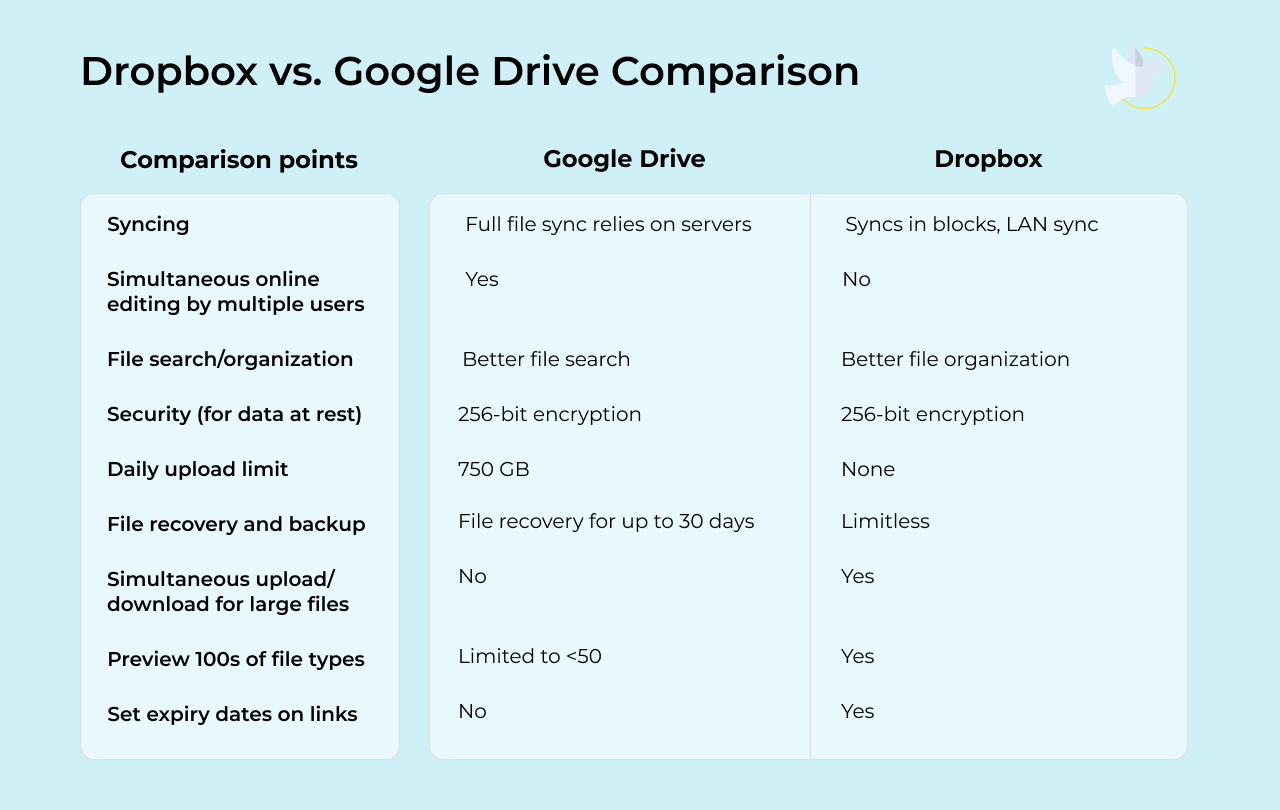
Dropbox vs. Google Drive Comparison Chart
Conclusion
The choice between Dropbox vs. Google Drive is a matter of personal preference. You might prefer Dropbox’s faster file synching, or you could choose Google’s free storage. Frankly, if we were to choose, we’d use both. You can do lots of things like sending emails using Gmail with new docs added to Dropbox or even save new file attachments from Gmail to Dropbox (and vice versa).